PhD position available in Evolutionary Genomics! |
|
“The role of chromosomal inversions in the diversification of common quail across a heterogeneous landscape”
Application: September 15th 2026
Funding: Spanish Ministry of Science
Duration: 4 years
Location: Doñana Biological Station (EBD-CSIC), Seville, Spain |
 |
We invite applications for a 4 year PhD position to work on the project:“The role of chromosomal inversions in the diversification of common quail across a heterogeneous landscape” (PID2025-175880NB-I00). The PhD candidate will be supervised by Carles Vilà and Carlos Leiva, and will join a research environment focused on understanding the evolutionary processes shaping biodiversity as member of the Conservation and Evolutionary Genetics Group.
The project
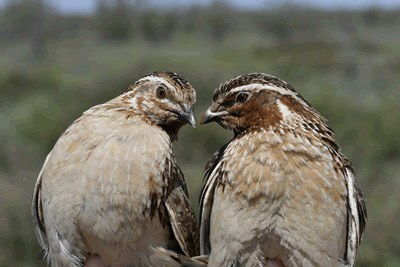
Chromosomal inversions are structural variants that can profoundly influence genome evolution, population differentiation, and adaptation. This PhD project will combine genomic data with ecological and evolutionary perspectives to understand how chromosomal variation interacts with landscape heterogeneity and gene flow, particularly in island environments, using a migratory bird, the common quail Coturnix coturnix, as the model organism.
The successful candidate will have the opportunity to address questions at the interface of evolutionary genomics, population biology, landscape genomics, and adaptation. The project as a whole is inherently multidisciplinary and combines field and laboratory work with bioinformatic analyses.
Candidate profile
We are looking for a highly motivated researcher with a strong interest in evolutionary biology, population genomics, and/or molecular ecology and a Master’s degree (or equivalent) in evolutionary biology, genomics, ecology, bioinformatics, zoology, or a related discipline.
Ideally, the candidate should also have:
• Previous experience with bioinformatic or genomic data analysis. Programming experience, particularly in R and/or Python, and familiarity with command-line environments.
• Willingness to acquire and develop laboratory skills in molecular genetics/ genomics and fieldwork and animal handling.
• Good analytical and problem-solving abilities. Ability to work independently while contributing positively to a collaborative research environment.
• Good written and spoken English.
A strong motivation to learn is more important than having experience in every technique used in the project.
Why join the Estación Biológica de Doñana (EBD-CSIC)?
The Estación Biológica de Doñana (EBD-CSIC) is one of Spain’s leading centers for research in ecology, evolution, biodiversity, and conservation. Located in Seville and closely connected to the exceptional natural laboratory provided by the Doñana region, EBD-CSIC offers an outstanding environment in which to investigate fundamental questions about biodiversity and its evolution.
One of EBD’s major strengths is its research-oriented training environment. PhD researchers become part of a broad scientific community encompassing evolutionary biology, ecology, genetics, animal behavior, conservation biology, and environmental sciences. This provides opportunities to interact with researchers working on complementary questions and approaches, facilitating collaborations that extend beyond the immediate PhD project.
PhD students are exposed not only to their own research projects but also to seminars, scientific discussions, collaborations, field activities, methodological training, and an international research community. The combination of fundamental and applied research creates opportunities to understand biodiversity from molecular and genomic processes through to populations, species, and ecosystems.
How to apply
Candidates should submit a CV by email, including a brief explanation on their motivation and relevant experience. The text should also provide contact information for one or two researchers that could provide references.
Applications should highlight, where applicable, experience in genomic laboratory techniques, bioinformatics, population genetics, R/Python programming, and analysis of high-throughput sequencing data as well as experience in the study of natural populations.
Applications and requests for additional information should be addressed to Carles Vilà (carles.vila@ebd.csic.es) and Carlos Leiva (carlos.leiva@ebd.csic.es) by september 15, 2026.
|